OM3 AQUA · Division 27
DAS & ERRCS Installation Contractors in New York
Public-safety radio coverage your fire marshal will sign off on, and cellular coverage your tenants will stop complaining about — surveyed, engineered and installed statewide.
- ERRCS / public-safety DAS
- Cellular DAS (carrier-grade)
- RF benchmark surveys
- BDA and fiber DAS head-ends
- NFPA / IFC code compliance
- AHJ acceptance testing
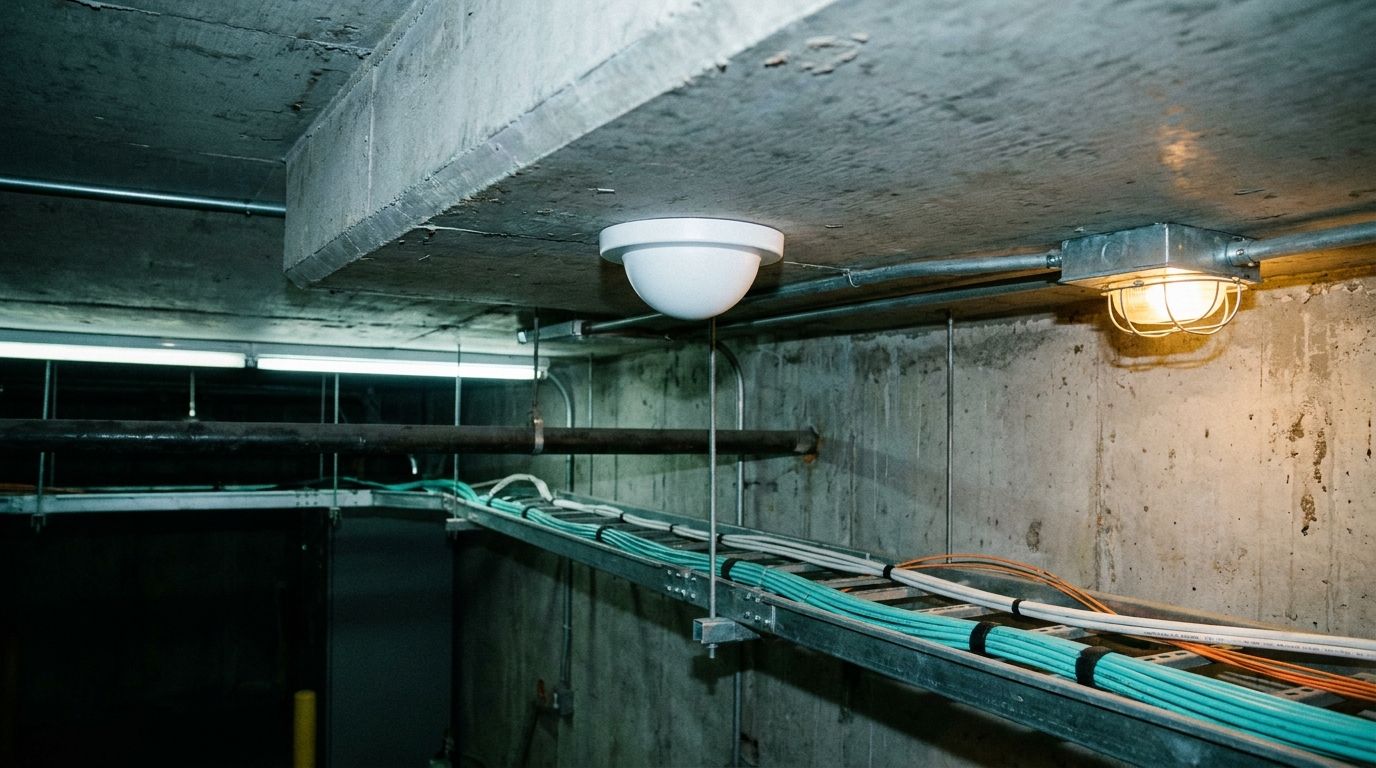
Two very different problems get solved by antennas in ceilings, and it pays to keep them straight. ERRCS — the Emergency Responder Radio Communication System, often called public-safety DAS — exists so firefighters' and police radios work in your stairwells, basements and interior corridors, and it's mandated by fire code for many buildings. Cellular DAS exists so your tenants' phones work, and while no code requires it, leasing agents will tell you dead zones show up in renewal conversations. Low Voltage New York scopes both across New York State and matches each project with partner crews that hold the right certifications for the system and the jurisdiction.
The code pressure is real and growing. Modern building and fire codes — following IFC Section 510 and NFPA standards — require minimum in-building radio coverage for emergency responders, typically demonstrated floor by floor, with critical areas like stairwells, fire command centers and elevator lobbies held to a stricter standard. New York City goes further, requiring Auxiliary Radio Communication (ARC) systems in new high-rise construction with FDNY plan approval and acceptance testing. Elsewhere in the state, county and municipal AHJs enforce their own versions, usually triggered at permit time for new construction, major renovations, or a change of occupancy.
Whether you're a developer who just got flagged at plan review, a property manager with a violation notice, or an owner getting ahead of the requirement, the path is the same: benchmark survey, engineered design, installation, and acceptance testing with the AHJ. We manage it end to end.
ERRCS and public-safety code compliance
An ERRCS project starts with an RF benchmark survey: technicians walk the building with calibrated equipment and measure existing public-safety radio signal on the frequencies your county's first responders actually use. If coverage falls short of the code threshold, the fix is an engineered system — a donor antenna on the roof, a signal booster (BDA) or fiber-fed head-end, and a distributed antenna network sized to bring every required area up to signal. Code typically demands high coverage percentages in general areas and stricter coverage in critical areas, along with survivability requirements: two-hour fire-rated enclosures or pathways for key components, NEMA-rated equipment, battery backup, and annunciation to the fire alarm panel.
Partner crews design to the local AHJ's amendments — which vary meaningfully between, say, FDNY's ARC rules in New York City and a county fire coordinator's requirements upstate — and carry the FCC licensing coordination with the frequency license holder that BDA deployments legally require.
- RF benchmark surveys with grid-based signal documentation
- BDA and fiber DAS design engineered to your AHJ's requirements
- Two-hour rated pathway and enclosure survivability
- Battery backup and fire alarm panel annunciation
- Coordination with the frequency license holder and AHJ through acceptance
Cellular DAS for tenant coverage
Cellular DAS solves a business problem instead of a code problem: modern glass, LEED-driven low-E coatings, concrete and below-grade space kill carrier signal, and tenants judge the building on their phones' bars. Solutions range from carrier-approved signal boosters for mid-size buildings to full multi-carrier DAS with dedicated head-end equipment for towers, campuses and venues. The economics differ from ERRCS too — carrier participation, rebroadcast agreements and equipment tiers shape the budget, and we'll be straight with you about which class of system your square footage and tenant profile actually justify.
Every cellular deployment includes the carrier coordination that legality requires: rebroadcasting a carrier's licensed spectrum needs their sign-off, and reputable integrators handle that paperwork rather than quietly skipping it.
From survey to acceptance testing
DAS projects fail at handoff points, so we manage the full sequence: benchmark survey and report, engineered design submitted for AHJ or carrier review, installation coordinated with the GC or building operations, commissioning, and the final walk test — often grid-by-grid with the fire marshal present for ERRCS. You get the survey data, design documents, test results and licensing paperwork as a package, which matters again at every annual retest.
Speaking of which: ERRCS isn't install-and-forget. Codes require periodic testing and the AHJ can demand proof, so we set up the recertification schedule before closeout instead of leaving it to the violation notice.
Projects we route every week
- ERRCS mandates on new construction
- Violation and plan-review remediation
- Cellular DAS for towers and campuses
- Annual ERRCS retesting and recertification
Coverage
DAS & ERRCS Installation by region
FAQ
DAS & ERRCS Installation — Common Questions
Does my building actually need an ERRCS?
It depends on your jurisdiction, building size, construction type and occupancy — the trigger is usually new construction, substantial renovation or change of occupancy, at which point the AHJ requires proof of in-building responder radio coverage. In New York City, new high-rises must install ARC systems under FDNY oversight. The honest first step is a benchmark survey: if your building already meets coverage thresholds, you may need documentation rather than a system, and we'll tell you which.
What does a DAS or ERRCS installation cost?
Square footage, construction type and required coverage drive it. A single BDA with a modest antenna network in a mid-size building is a very different project from a fiber-fed system in a concrete tower with two-hour rated pathway throughout. Survivability requirements — rated enclosures, battery runtime, annunciation — add real cost to ERRCS that cellular systems don't carry. We survey first, then quote from measured data instead of assumptions.
Who signs off on an ERRCS, and what does acceptance involve?
Your local authority having jurisdiction — FDNY in New York City, typically the fire marshal or county fire coordinator elsewhere in the state. Acceptance usually means a grid-based walk test demonstrating required signal strength in general and critical areas, verification of survivability features like battery backup and rated enclosures, and confirmation of alarm panel annunciation. We schedule and attend the acceptance test and deliver the documentation package the AHJ keeps on file.
Do carriers have to approve a cellular DAS?
Yes — rebroadcasting a carrier's licensed spectrum requires their consent, formalized in a rebroadcast or retransmission agreement, and larger systems involve carrier engineering review of the design. Timelines for carrier approval vary and can be the longest item on the schedule, so we start that coordination at design time. Skipping it isn't an option we offer; unauthorized rebroadcast creates FCC exposure for the building owner.
How long does an ERRCS project take from survey to sign-off?
The survey and report are quick — typically a couple of weeks including scheduling. Design, AHJ review, equipment procurement and installation follow, with total timelines commonly running a few months depending on building size, AHJ review queues and equipment lead times. If you're facing a certificate-of-occupancy deadline, tell us the date up front: sequencing the AHJ submittal early is the single biggest schedule lever.
Pricing a das & errcs installation project?
Tell us what you need. A licensed New York crew prices it — free, within 48 hours.