FIBER ORANGE · Division 27
Fiber Optic Cabling Contractors in New York
Backbone, riser and campus fiber — fusion-spliced, terminated and OTDR-tested by crews who do this every week. Multimode OM3–OM5 and single-mode, statewide.
- Fusion splicing
- OM3 / OM4 / OM5 multimode
- OS2 single-mode
- Backbone and riser runs
- Campus and OSP fiber
- OTDR + insertion loss testing
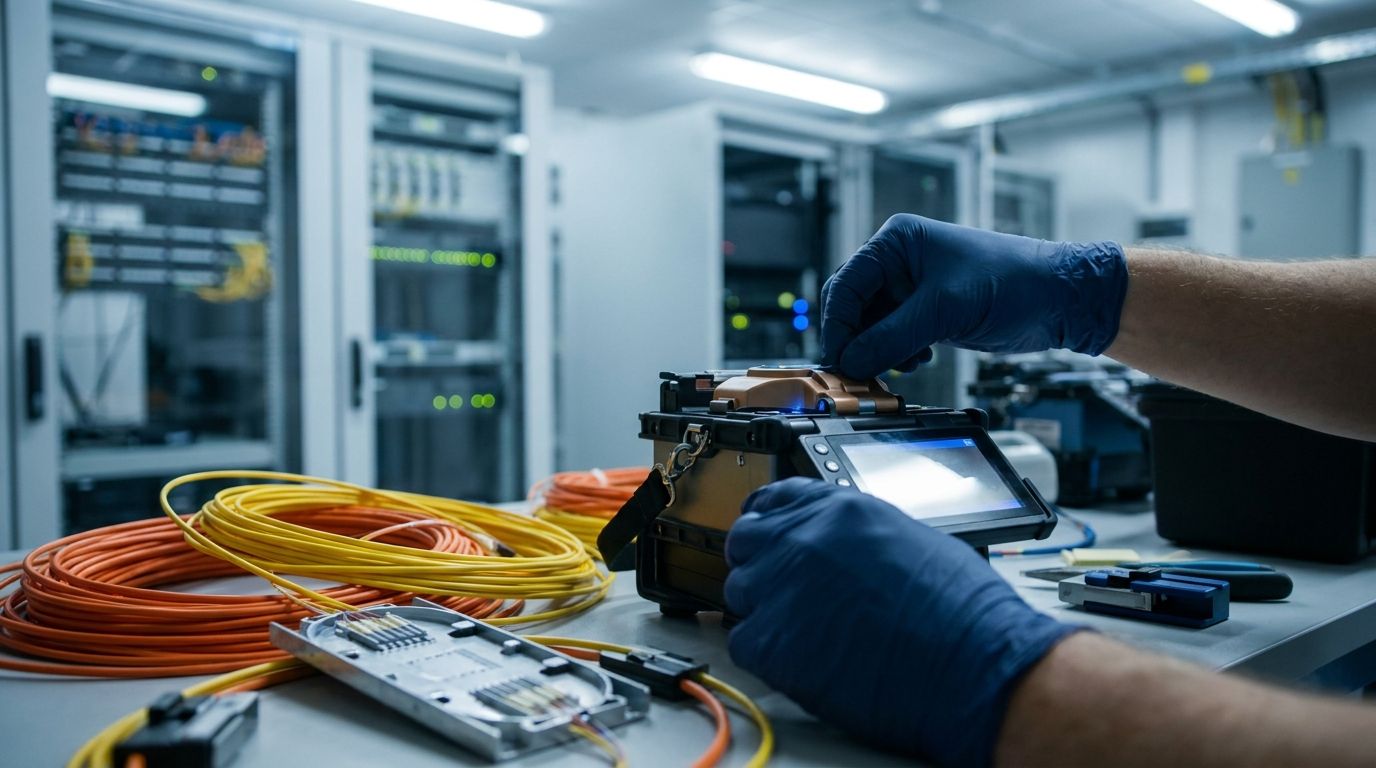
Fiber is where cabling stops being forgiving. A sloppy copper termination still passes traffic; a dirty ferrule or a stressed bend in a fiber trunk shows up as errors your network team will chase for months. When New York businesses come to us for fiber optic cabling — a new riser backbone, a link between buildings, splicing after a contractor's excavator found your conduit — we match the job with partner crews that splice and test fiber constantly, not occasionally.
The scope range is wide. Inside buildings: multimode OM3, OM4 or OM5 and single-mode backbone between the MDF and IDFs, riser trunks through sleeves and cores, and fiber to high-bandwidth endpoints like imaging equipment or production machinery. Between buildings: campus and outside-plant runs in conduit or aerial, armored and gel-free cable selected for the pathway, with entrance transitions handled to code. Every strand is fusion-spliced or field-terminated to spec and delivered with test results.
We scope from your riser diagrams, site plans, or a walk-through, and return an estimate within 48 hours — with strand counts, connector types and test methodology spelled out, so you can compare bids on substance instead of a bottom-line number.
Backbone, riser and campus fiber
Vertical backbone is the classic case: multi-strand trunks from the MDF up through the riser to each floor's IDF, sized with spare strands because pulling fiber twice costs more than pulling extra once. For campuses — hospitals, schools, industrial sites, multi-building offices — partner crews run single-mode between buildings through existing duct banks or new conduit, handling the wet-to-dry transition, grounding of armored cable, and slack loops at each end.
Single-mode is the default for any new backbone or campus run: the cable itself is cheap, distance limits effectively disappear, and it won't be the reason you re-cable in ten years. Multimode still makes sense inside data rooms and for short runs where existing optics dictate it — we'll match what your switching hardware actually needs.
- Riser backbone trunks, MDF to IDF, with spare-strand planning
- Campus and building-to-building runs in conduit, duct bank or aerial
- Entrance facility transitions, grounding and slack management
- Armored, indoor/outdoor and plenum-rated cable selection to match the pathway
Fusion splicing and termination
Partner crews run core-alignment fusion splicers and build splice cases and trays that another technician can open five years later without cursing. Pigtail splicing onto factory-polished connectors is our default for backbone terminations — it produces lower, more consistent loss than field polishing, and it's faster on multi-strand counts. Pre-terminated assemblies make sense for some jobs and we'll say so when they do.
Emergency splicing is part of the trade: cut conduits, storm damage, a dark building waiting on a repair. If you have fiber down in New York State, call — restoring a severed trunk is exactly the kind of job the network exists to staff fast.
Testing, documentation and acceptance
Every fiber job closes with bidirectional insertion loss testing against a calculated loss budget, and OTDR traces where the spec or the run length warrants them — which for backbone and campus work is essentially always. You receive the results per strand, labeled to match the patch panels, along with splice locations and as-built routing. If a link ever degrades, that baseline turns a mystery into a diff.
Acceptance criteria get agreed before work starts: loss budget per link, connector grade, and what happens if a strand fails — re-splice, re-terminate or re-pull. Written down, it protects both sides.
Projects we route every week
- Riser and backbone fiber build-outs
- Campus and building-to-building links
- Emergency splicing and fiber repair
- Fiber upgrades for bandwidth-heavy tenants
Coverage
Fiber Optic Cabling by region
FAQ
Fiber Optic Cabling — Common Questions
What drives the cost of a fiber optic cabling job?
Strand count, run length and pathway condition dominate. A 12-strand riser trunk through open sleeves is a quick job; the same trunk through packed cores that need boring, or a campus run requiring trenching and new conduit, is mostly a pathway project with fiber at the end of it. Splicing and testing scale with strand count. We break all of this out in the estimate so you can see where the money actually goes.
Should I install multimode or single-mode fiber?
For new backbone and any building-to-building run, single-mode (OS2) is almost always right — the cable cost difference is trivial, distance limits vanish, and it stays useful through every future speed upgrade. Multimode OM4/OM5 remains sensible for short in-room runs where your existing optics are multimode and replacing them would cost more than the cable. We'll look at your switch hardware before recommending.
Can you repair fiber that was cut by another contractor?
Yes — cut-fiber restoration is one of the most common emergency calls we field. Partner crews locate the damage, assess whether a mid-span splice case or a section replacement is the right fix, fusion-splice the strands, and re-test the full link against its loss budget. Bring whatever documentation exists on the original run; if there is none, the OTDR finds the break anyway.
Do outdoor or underground fiber runs need permits?
Work on your own property in existing conduit typically doesn't, but new trenching, road crossings, aerial attachments to utility poles, or anything in the public right-of-way involves permits and utility coordination — including One Call / 811 markouts before any digging, which is required by law in New York. Our partner crews manage the markout and permitting process as part of the scope rather than leaving it to you.
What test documentation do I get when the job is done?
Bidirectional insertion loss results for every strand, measured against the loss budget we agreed at scoping, plus OTDR traces on backbone and long runs showing each splice and connector event. Results are labeled to match the physical patch panels and delivered with as-built routing. It's the difference between owning a fiber plant and merely having one.
Pricing a fiber optic cabling project?
Tell us what you need. A licensed New York crew prices it — free, within 48 hours.