OM3 AQUA · Division 27 · Long Island
DAS Installation Contractors on Long Island
Serving Hempstead, Melville, Hauppauge, Farmingdale, Garden City and every commercial corridor in Long Island.
- ERRCS / public-safety DAS
- Cellular DAS (carrier-grade)
- RF benchmark surveys
- BDA and fiber DAS head-ends
- NFPA / IFC code compliance
- AHJ acceptance testing
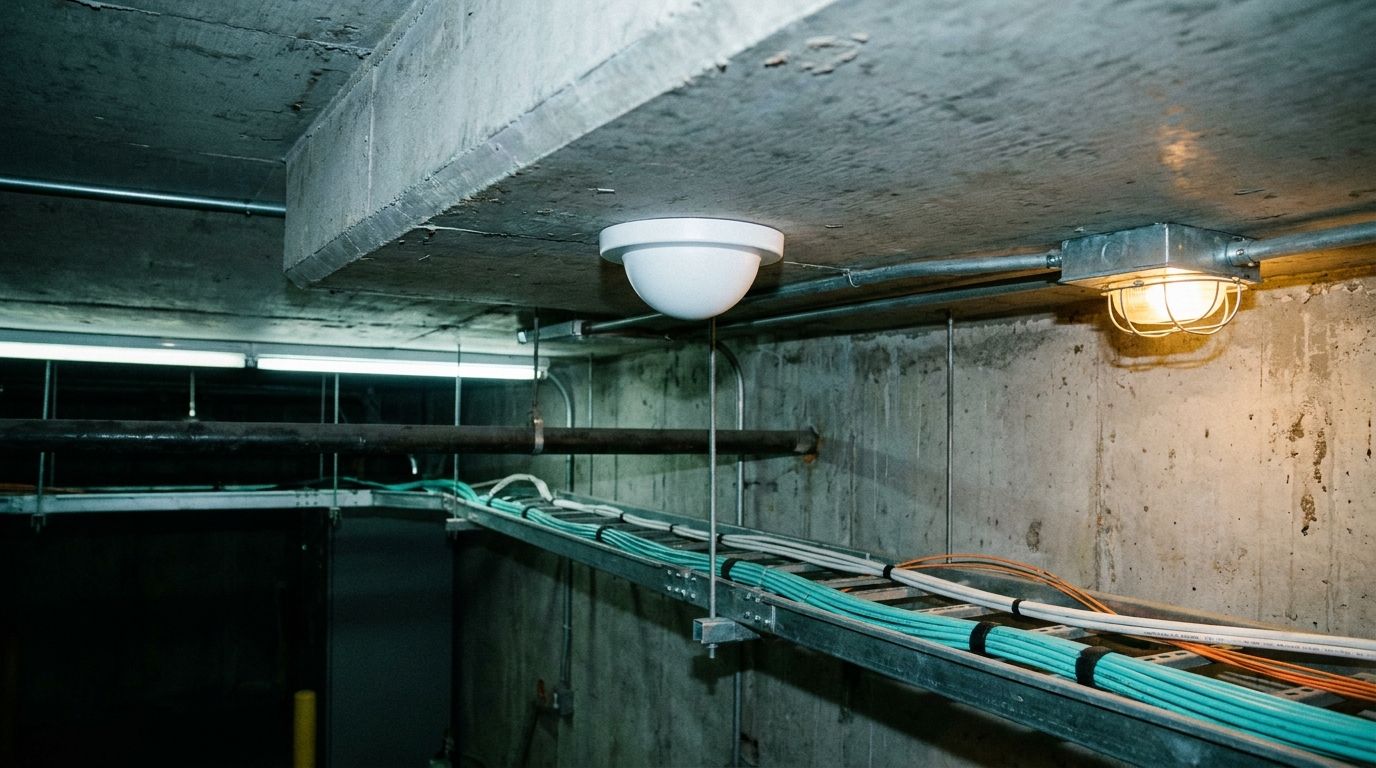
Long Island's DAS problem is horizontal, not vertical. The Island's commercial stock is full of big, low buildings — tilt-up warehouses, steel-framed industrial plants in the Hauppauge park, sprawling medical and office buildings — whose metal skins and deep interiors block cellular signal just as effectively as any Manhattan core. Employees walk toward windows to take calls, dock offices lose connectivity entirely, and safety plans that assume workers can dial out from anywhere quietly don't hold.
Our partner crews design and install both cellular DAS and public-safety (emergency responder) coverage systems for Island facilities. The engagement starts with a signal survey that maps real coverage floor by floor, then a design matched to the building — antenna layouts that account for racking and mezzanines in warehouses, and coverage in the stairwells, basements and interior corridors that public-safety criteria focus on. Where a local fire marshal requires responder coverage verification, we build the testing and documentation into the project.
DAS & ERRCS Installation where you are
Fire district requirements are the quiet variable on Long Island DAS work. Responder radio coverage expectations are enforced locally, and what a fire marshal in one Suffolk town requires for a new warehouse can differ from the neighboring jurisdiction's standard. Our crews treat the AHJ conversation as step one on public-safety projects — confirming the applicable criteria in writing before design — so the system is engineered to pass the test it will actually be given.
Our Long Island partner crews regularly work Hauppauge Innovation Park, Route 110 corridor (Melville–Farmingdale), Garden City / Mineola office and medical corridor and the surrounding commercial areas — so mobilization is measured in days, not weeks.
What the work includes
An ERRCS project starts with an RF benchmark survey: technicians walk the building with calibrated equipment and measure existing public-safety radio signal on the frequencies your county's first responders actually use. If coverage falls short of the code threshold, the fix is an engineered system — a donor antenna on the roof, a signal booster (BDA) or fiber-fed head-end, and a distributed antenna network sized to bring every required area up to signal. Code typically demands high coverage percentages in general areas and stricter coverage in critical areas, along with survivability requirements: two-hour fire-rated enclosures or pathways for key components, NEMA-rated equipment, battery backup, and annunciation to the fire alarm panel.
Partner crews design to the local AHJ's amendments — which vary meaningfully between, say, FDNY's ARC rules in New York City and a county fire coordinator's requirements upstate — and carry the FCC licensing coordination with the frequency license holder that BDA deployments legally require.
- RF benchmark surveys with grid-based signal documentation
- BDA and fiber DAS design engineered to your AHJ's requirements
- Two-hour rated pathway and enclosure survivability
- Battery backup and fire alarm panel annunciation
- Coordination with the frequency license holder and AHJ through acceptance
FAQ
DAS & ERRCS Installation in Long Island — Questions
Our new Long Island warehouse failed its radio coverage check. What now?
This is a common trigger for public-safety DAS on the Island — big steel buildings routinely fail responder coverage testing. We confirm the fire district's specific criteria, survey the building, and design an emergency responder coverage system to meet them, including the acceptance testing and documentation the AHJ signs off on.
Can DAS fix cell coverage in just part of our building, like the dock offices?
Yes. DAS designs can target the zones that actually fail — dock offices, interior production areas, basement levels — rather than blanketing square footage that already has signal. The benchmark survey establishes exactly where coverage drops, and the design and budget follow from that map.
Does my building actually need an ERRCS?
It depends on your jurisdiction, building size, construction type and occupancy — the trigger is usually new construction, substantial renovation or change of occupancy, at which point the AHJ requires proof of in-building responder radio coverage. In New York City, new high-rises must install ARC systems under FDNY oversight. The honest first step is a benchmark survey: if your building already meets coverage thresholds, you may need documentation rather than a system, and we'll tell you which.
What does a DAS or ERRCS installation cost?
Square footage, construction type and required coverage drive it. A single BDA with a modest antenna network in a mid-size building is a very different project from a fiber-fed system in a concrete tower with two-hour rated pathway throughout. Survivability requirements — rated enclosures, battery runtime, annunciation — add real cost to ERRCS that cellular systems don't carry. We survey first, then quote from measured data instead of assumptions.
Need das in Long Island?
Tell us what you need. A licensed New York crew prices it — free, within 48 hours.