CAT6 BLUE · Division 27 · Western New York
Structured Cabling Contractors in Western New York
Serving Buffalo, Rochester, Niagara Falls, Amherst, Cheektowaga and every commercial corridor in Western New York.
- Cat6 / Cat6A / Cat8
- OM3–OM5 + single-mode fiber
- IDF/MDF build-outs
- Fluke-certified testing
- TIA-568 / TIA-606 compliant
- 25-year manufacturer warranties
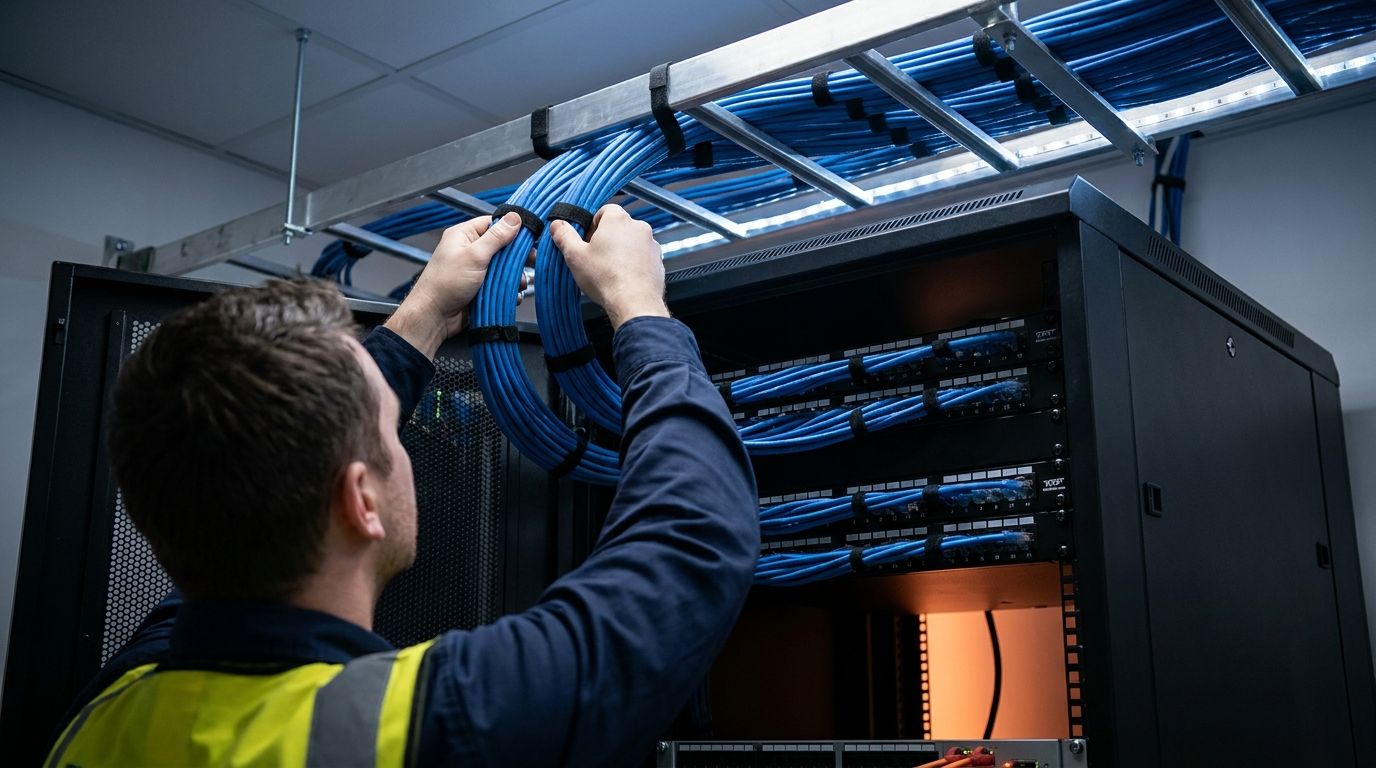
Western New York cabling work spans two distinct city profiles. Buffalo's commercial core mixes the Buffalo Niagara Medical Campus, a downtown running heavy on adaptive reuse — century-old brick and timber buildings converted to offices and tech space — and heavy industry along the river. Rochester brings the optics and photonics cluster, Eastman Business Park's sprawling industrial acreage, and a university-and-hospital economy anchored by the U of R medical system.
Those buildings punish lazy installs. Adaptive-reuse projects mean masonry walls, timber joists and zero existing pathway, so crews design conduit and surface raceway routes instead of just fishing cable. Medical campus work means infection-control procedures and occupied-floor scheduling. Manufacturing sites mean industrial-rated cable and separation from high-voltage equipment. We match every Western NY project with a partner crew that has done that specific building type before, and every link ships with certified test results.
Structured Cabling where you are
Buffalo's converted warehouses and Rochester's legacy industrial parks share a common trait: thick masonry construction that eats wireless signal and complicates every cable route. Structured cabling in these buildings is the backbone strategy, not the fallback — hardwired drops and fiber risers do the work that access points alone can't. Crews in our Western NY network treat pathway design in old construction as its own scoping line item, priced honestly up front.
Our Western New York partner crews regularly work Buffalo Niagara Medical Campus, Eastman Business Park (Rochester), RiverBend / South Buffalo advanced-manufacturing district and the surrounding commercial areas — so mobilization is measured in days, not weeks.
What the work includes
A complete structured cabling scope runs from the demarc to the desktop. Our partner crews handle design and engineering support, rough-in coordination with the GC and electrician, cable pull and termination, and closeout documentation. On new construction we work from the Division 27 spec and respond to RFIs; on retrofits we field-verify pathways before quoting so there are no surprises above the ceiling.
- Horizontal cabling — Cat6, Cat6A or Cat8 drops to workstations, APs, cameras and printers
- Backbone cabling — multi-strand fiber or copper trunks between the MDF and each IDF
- Telecom room build-outs — racks, cabinets, ladder rack, patch panels, grounding and bonding
- Pathway and support — J-hooks, cable tray, sleeves, conduit stubs, firestopping at penetrations
- Testing and certification — Fluke DSX channel testing with results delivered for every link
- Labeling and as-builts — TIA-606 labeling at both ends plus patch panel schedules and floor plans
FAQ
Structured Cabling in Western New York — Questions
Can you cable a converted loft or adaptive-reuse office building in Buffalo?
Yes — it's a signature Western NY project type. Exposed-ceiling conversions need routing that looks intentional, penetrations through masonry need coring rather than drilling and hoping, and landmark-sensitive buildings need methods facilities will approve. We scope pathway design as its own line so there are no surprises mid-install.
Do your crews work on the Buffalo Niagara Medical Campus and other clinical sites?
Our network includes crews experienced in occupied healthcare buildings, which is what campus work demands: infection-control barriers, above-ceiling permits where the facility requires them, and pulls scheduled around clinical operations. Clinical experience is a hard requirement for the crews we assign to those projects.
How much does structured cabling cost per drop in New York?
It depends on cable category, run lengths, ceiling conditions and labor market — a Cat6 drop in an accessible-ceiling suburban office costs meaningfully less than a Cat6A plenum run in a Manhattan high-rise with after-hours access rules. Union labor and prevailing-wage projects also price differently than open-shop work. Rather than quote a misleading flat number, we scope your actual conditions and return a per-drop price within 48 hours.
How long does a typical office cabling project take?
A 50–100 drop office fit-out typically installs in one to two weeks once materials are on site, assuming normal ceiling access. New construction runs on the GC's schedule — rough-in during framing, trim and termination after walls close, testing before turnover. Occupied-space retrofits done after hours take longer in calendar days but avoid disrupting your staff. We give you a schedule with the estimate, not after the deposit.
Need cabling in Western New York?
Tell us what you need. A licensed New York crew prices it — free, within 48 hours.