CAT6 BLUE · Division 27 · Capital Region
Structured Cabling Contractors in the Capital Region
Serving Albany, Schenectady, Troy, Saratoga Springs, Colonie and every commercial corridor in Capital Region.
- Cat6 / Cat6A / Cat8
- OM3–OM5 + single-mode fiber
- IDF/MDF build-outs
- Fluke-certified testing
- TIA-568 / TIA-606 compliant
- 25-year manufacturer warranties
The Capital Region's cabling market is defined by two anchors: New York State government and Tech Valley. State agencies and the contractors who serve them fill office space across Albany, from the Empire State Plaza to the Harriman campus, and public-sector work means prevailing-wage requirements and formal submittal processes. On the private side, the semiconductor corridor running from the Albany NanoTech Complex up to GlobalFoundries in Malta has pulled suppliers, labs and engineering firms into the region, all of them cabling-hungry.
Our network fields Capital Region crews that can operate in both worlds. For public and prevailing-wage projects, that means certified payroll and documentation handled correctly from the first mobilization. For private fit-outs in Albany, Troy, Schenectady and Saratoga County, it means standard commercial timelines: scope in 48 hours, Cat6 or Cat6A pulled and terminated to spec, and Fluke test results delivered with the closeout package.
Structured Cabling where you are
Semiconductor-adjacent facilities are the region's most exacting cabling environments — cleanroom-adjacent spaces, ESD-sensitive areas and specifications written by national engineering firms rather than local IT managers. Crews in our Capital Region network have worked supplier and lab build-outs in the Malta and Albany nanotech orbit and are used to installing against a formal spec book, not just a floor plan with drop counts.
Our Capital Region partner crews regularly work Empire State Plaza and downtown Albany state office core, Harriman State Office Campus (Albany), Albany NanoTech Complex / Fuller Road corridor and the surrounding commercial areas — so mobilization is measured in days, not weeks.
What the work includes
A complete structured cabling scope runs from the demarc to the desktop. Our partner crews handle design and engineering support, rough-in coordination with the GC and electrician, cable pull and termination, and closeout documentation. On new construction we work from the Division 27 spec and respond to RFIs; on retrofits we field-verify pathways before quoting so there are no surprises above the ceiling.
- Horizontal cabling — Cat6, Cat6A or Cat8 drops to workstations, APs, cameras and printers
- Backbone cabling — multi-strand fiber or copper trunks between the MDF and each IDF
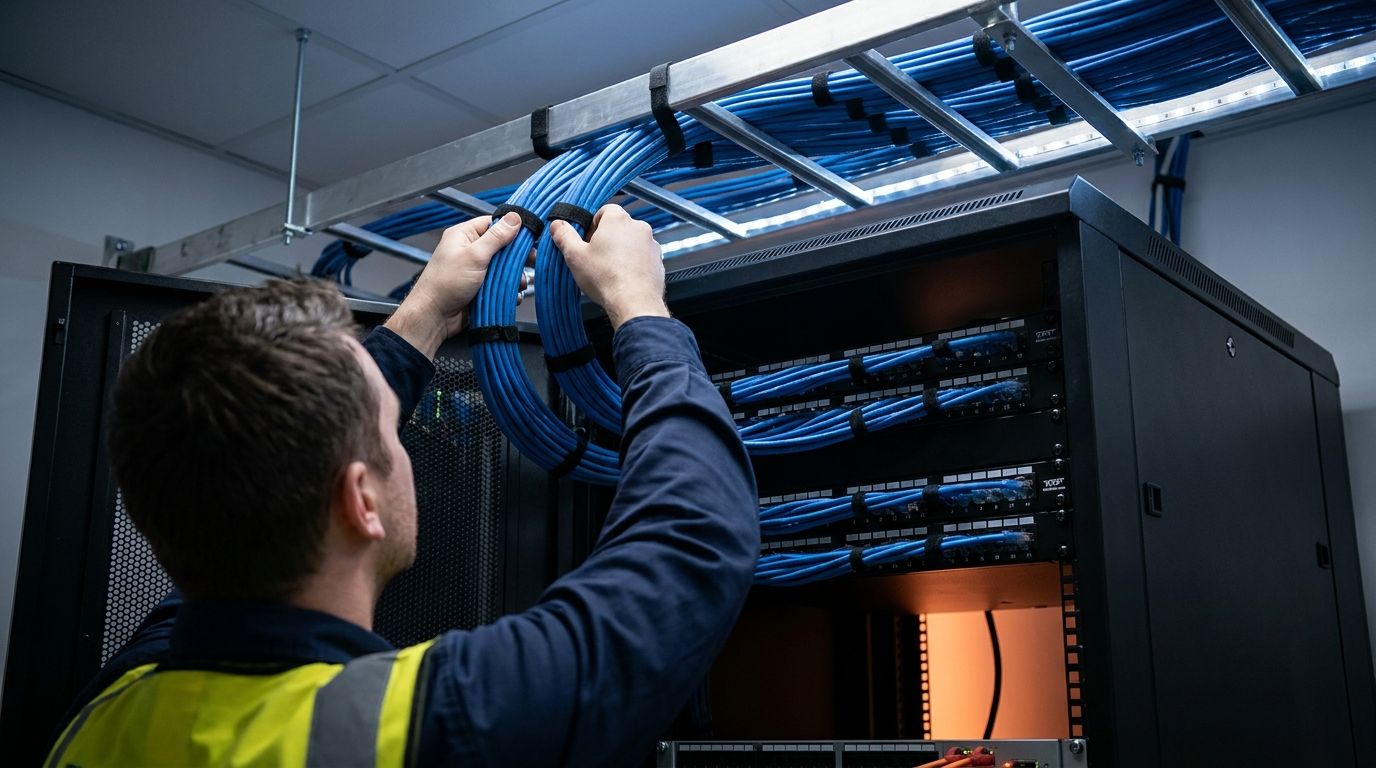
- Telecom room build-outs — racks, cabinets, ladder rack, patch panels, grounding and bonding
- Pathway and support — J-hooks, cable tray, sleeves, conduit stubs, firestopping at penetrations
- Testing and certification — Fluke DSX channel testing with results delivered for every link
- Labeling and as-builts — TIA-606 labeling at both ends plus patch panel schedules and floor plans
FAQ
Structured Cabling in Capital Region — Questions
Can you work on prevailing-wage or state-funded projects in Albany?
Yes. New York public work carries prevailing-wage requirements, and we match those projects with crews set up for certified payroll and public-sector documentation. Flag the funding source when you request an estimate and the quote will reflect the correct labor rates from the start.
Do you serve Saratoga County and the Malta area?
Yes — the semiconductor corridor from Albany through Malta and into Saratoga Springs is core coverage territory for our Capital Region crews, along with Troy, Schenectady and the surrounding counties. Supplier build-outs and lab fit-outs in that corridor are a regular part of the project mix.
How much does structured cabling cost per drop in New York?
It depends on cable category, run lengths, ceiling conditions and labor market — a Cat6 drop in an accessible-ceiling suburban office costs meaningfully less than a Cat6A plenum run in a Manhattan high-rise with after-hours access rules. Union labor and prevailing-wage projects also price differently than open-shop work. Rather than quote a misleading flat number, we scope your actual conditions and return a per-drop price within 48 hours.
How long does a typical office cabling project take?
A 50–100 drop office fit-out typically installs in one to two weeks once materials are on site, assuming normal ceiling access. New construction runs on the GC's schedule — rough-in during framing, trim and termination after walls close, testing before turnover. Occupied-space retrofits done after hours take longer in calendar days but avoid disrupting your staff. We give you a schedule with the estimate, not after the deposit.
Need cabling in Capital Region?
Tell us what you need. A licensed New York crew prices it — free, within 48 hours.